A Depression-Circuit Enriched GPCR for Targeted Pharmacotherapy
Project Overview
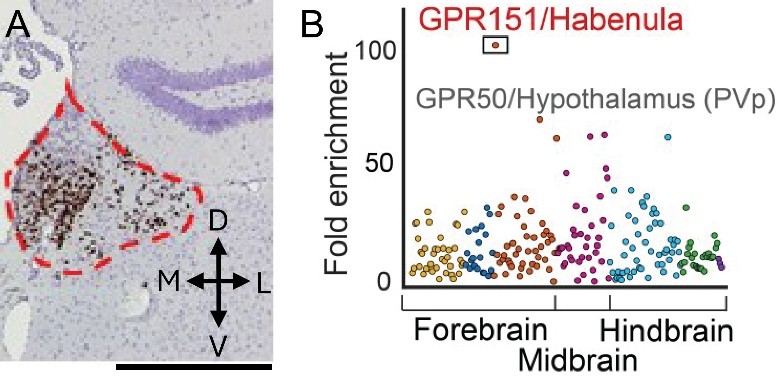
Inflammation-associated depression is a clinically important and often treatment-resistant subtype of major depressive disorder. We identified GPR151, an orphan G protein-coupled receptor exceptionally enriched in the habenula (Fig. 3A,B), as a highly promising therapeutic target for this condition. We found that GPR151 shows conserved topography and maintains similar expression relationships with other habenular markers in both mice and humans. In mice, GPR151 deletion reduced passive coping following an inflammatory challenge in both sexes, despite preserving normal peripheral sickness and immune activation. Furthermore, restoring GPR151 expression in the adult male habenula successfully increased inflammation-induced amotivation without exacerbating weight loss or immune activation, though interestingly, this same manipulation was insufficient in females.
In this project, our lab seeks to dissect this highly specific receptor pathway using state-of-the-art methodology. We aim to determine exactly how GPR151 drives inflammation-associated depressive behaviors, to uncover the divergent circuit-level mechanisms of action between males and females, and to definitively evaluate its viability as a targeted pharmacotherapy.
Methodology
- Cross-Species Mapping: Comparing GPR151 topography and expression relationships alongside other habenular markers in both murine and human tissue (Fig. 3A,B).
- Genetic & Viral Modeling: Utilizing whole-body GPR151 deletion and targeted viral restoration in the adult habenula to isolate the receptor's neurological influence from general physiological responses.
- Behavioral Assays: Measuring passive coping and amotivation following inflammatory challenges to accurately model treatment-resistant depression subtypes.
- Physiological Monitoring: Tracking variables like peripheral sickness, weight loss, and systemic immune activation to ensure observed behavioral shifts are neurologically driven rather than secondary to physical illness.
Current Objectives
To gain precise spatial and temporal control over this receptor, we are currently breeding a newly generated line of floxed GPR151 mice. Using this model, we will test whether the highly specific removal of GPR151 directly within the habenula affects a subject's affective bias and alters their sensitivity to the amotivational effects of chronic stress.