A Synaptic Mechanism for Creating and Diversifying Reinforcement Signals
Project Overview
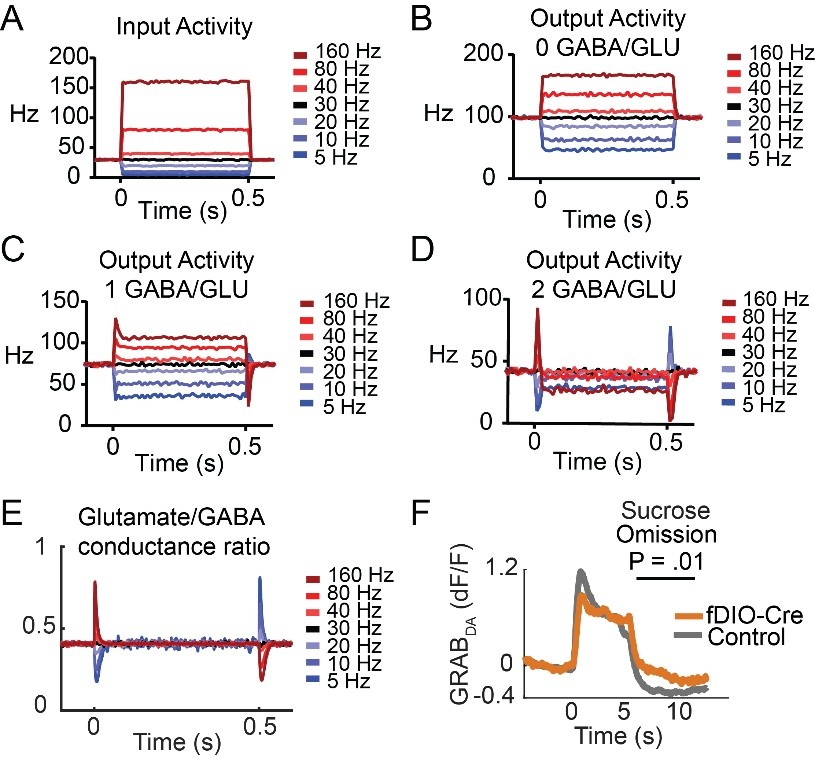
We discovered the co-release of GABA with glutamate from individual synaptic vesicles within the lateral habenula (LHb), a dual-transmission phenomenon whose levels are altered in conditions related to depression. Using biophysically realistic neural simulations, we demonstrated that this co-release of opposing neurotransmitters is sufficient to produce temporal-difference (TD) like computations (Fig. 2A-E), which are critical for reinforcement learning. Furthermore, our simulations indicate that varying the ratio of glutamate-to-GABA transmission, as seen ex vivo, generates the diverse reinforcement signals (Fig. 2C,D) required for value distribution learning. Supporting the behavioral importance of this mechanism, our evolutionary analyses using machine learning and scRNA-seq reveal that these specialized glutamate/GABA terminals have proliferated from fish to monkeys, likely reflecting the increasing complexity of reinforcement learning in mammals.
In this project, our lab seeks to dissect the functional impact of this dual-transmission mechanism using state-of-the-art methodology. We aim to determine how this unique synaptic co-release acts as a fundamental mechanism to not only create, but also diversify, the reinforcement signals required for sophisticated learning and value computation.
Methodology
- Biophysical Neural Simulations: Modeling how the co-release of GABA and glutamate computes temporal-difference (TD) signals and generates diverse reinforcement outputs (Fig. 2A-E; Fig. 2C,D).
- Viral and Genetic Targeting: Utilizing fDIO-Cre mice to selectively eliminate GABA co-release from glutamatergic neurons, allowing us to isolate its specific physiological functions without disrupting standard transmission.
- In Vivo Dopamine Recordings: Measuring downstream dopamine release in the nucleus accumbens (NAc) during behavioral tasks (e.g., sucrose omission) to validate the necessity of GABA co-release in generating TD reinforcement signals (Fig. 2F).
- Computational & Molecular Profiling: Applying machine learning identification of synaptic labeling, topographic mapping, and single-cell RNA sequencing (scRNA-seq) to track the cellular diversity and evolutionary expansion of these terminals.
Current Objectives
Building on our preliminary in vivo data, which shows that removing GABA co-release prevents standard dopamine dips during reward omission (Fig. 2F), we are now expanding our behavioral focus. We want to determine if this synaptic mechanism directly contributes to distributional value coding across the brain and drives affective bias in individual mice.