Neural Mechanisms of Affective Bias
Project Overview
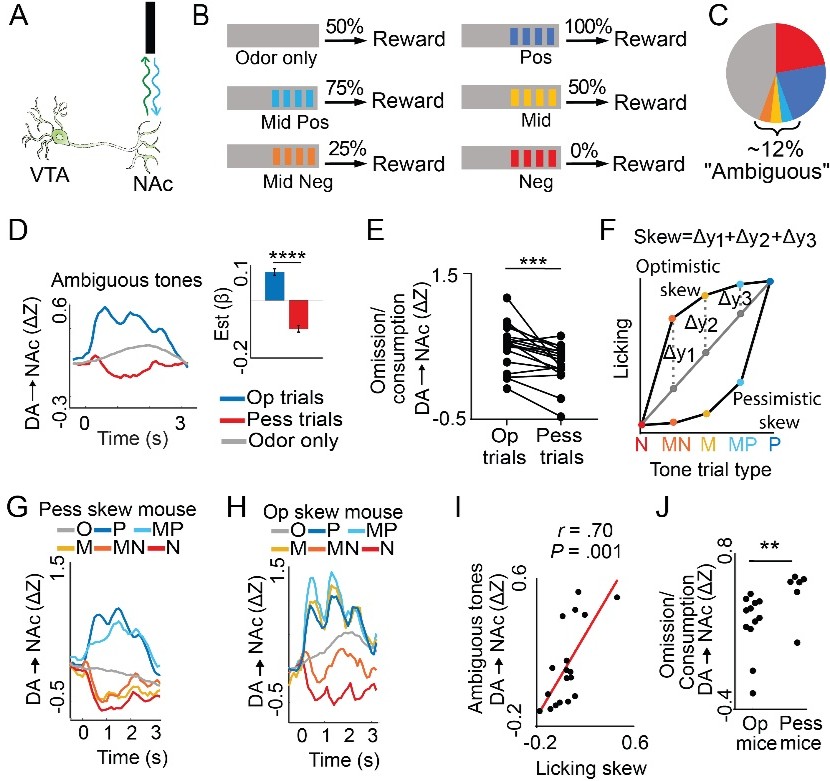
We developed a novel Pavlovian ambiguous-cue task to measure affective bias in mice (Fig. 1B,C). By combining this behavioral paradigm with observations of dopamine projections to the nucleus accumbens (DA→NAc; Fig. 1A), we successfully identified distinct dopaminergic signatures of “state” (transient) and “trait-like” (persistent) pessimism. Our findings demonstrate that state pessimism is driven by reduced DA→NAc activity during ambiguous cues (Fig. 1D) and compensatory reduced reward omission signals relative to reward consumption signals (Fig. 1E). In contrast, persistent pessimistic bias is sustained by decreased cue-evoked activity (Fig. 1G-I) paired with amplified reward omission signals (Fig. 1J).
In this project, our lab seeks to dissect these specific dopaminergic and habenular circuits using state-of-the-art methodology. We aim to determine how chronic stress and distinct populations of LHb neurons modulate these downstream dopamine signals to compute and sustain pessimistic affective states.
Methodology
- Behavioral Modeling: Utilizing a custom Pavlovian ambiguous-cue task (Fig. 1B,C) to accurately measure and differentiate state versus trait-like affective bias in mice.
- Fiber Photometry: Recording dynamic dopamine projections to the nucleus accumbens (DA→NAc; Fig. 1A) in real-time during cue presentation, reward consumption, and reward omission.
- Optogenetics: Perturbing specific dopaminergic pathways during positive and negative feedback to establish causal relationships in behavioral responses.
Current Objectives
We are currently examining how chronic stress and specific lateral habenula (LHb) neuron types affect both behavior and DA→NAc responses within our task. Furthermore, we plan to use targeted optogenetic perturbation during positive and negative feedback to confirm the causal role these dopamine projections play in the induction and maintenance of affective bias.